Weak spray from a zone
What it means: A clogged nozzle, leaking line, or valve that does not open fully can reduce pressure at the heads.
What we check: Check zone pressure, nozzle condition, and valve operation.
Tell us what you're seeing, we'll give you a straight answer and a free quote in Denton.
Straight Answers
A short phone call is enough to start, no pressure, no obligation.

No obligation
Call (940) 304-8736What happens next
One corner of the lawn is a bog while the rest turns brown. Or a head is spraying the driveway, or the whole system sits dead while the grass dies. We repair sprinklers across Denton, and the quickest way to find out what you're dealing with is a call to us. We'll name the actual fault, give you a written quote, and tell you straight if nothing needs fixing.
Tap whichever one sounds most like your situation.
Mostly because of the ground they sit in. Where the clay is dry, it cracks deeply and swallows water fast through those cracks. When it's moist, water moves through it very slowly. A yard that swings between bone dry and saturated is hard on a system, and runoff is the tell. If water runs off your lawn instead of soaking in, the zone is probably running too long, or a head is aimed or sunk wrong.
Age is the other cause. The median Denton home was built in 1995, so many systems have been running a long time. Heads wear out, valves stick, and controllers lose their programming.
A sprinkler system in Denton has to fit a few city rules, and they explain a lot of what goes wrong with one. These rules apply to homes on City of Denton water. If your water bill comes from another provider, as it may in a neighboring town, check that provider's rules instead.
The city's twice-a-week schedule goes by the last digit of your street number. Even numbers water on Tuesday and Saturday, and so do properties with no number. Odd numbers water on Wednesday and Sunday. Commercial and multifamily properties water on Monday and Thursday.
From June 1 through September 30, sprinklers may not run between 10 a.m. and 6 p.m. Hand watering and soaker hoses along a foundation are exempt.
Hose-end sprinklers count as irrigation. Drip lines are not on the day schedule, but they still must not cause runoff.
The city says most lawns need about an inch of water a week, rain included. If your controller runs on other days, change that setting first.
Denton requires every backflow prevention assembly to be tested at least once a year. A home with a sprinkler system has at least one on the irrigation line.
For Dallas/Fort Worth, the National Weather Service lists November 22 as the average first freeze. Texas A&M's School of Irrigation gives four steps that protect most Texas systems from light to mild freezes:
Denton's irrigation permit checklist asks installers to show owners how to winterize, especially the backflow device.
There is a billing reason to switch off, too. The city works out your wastewater charge from a percentage of the water you use from December through February, so sprinkler runs in those months can raise it.
Homeowners on City of Denton water can get back up to $100 of a sprinkler tune-up by a licensed irrigator. You can claim it up to twice in 12 months, as long as the controller is set to your address's watering days. The full rules, with a link to each city page, are in the Denton watering rules guide.
Everyday repairs make up most of the work: heads that don't pop up, heads that spray the wrong way or miss part of the lawn, leaks that leave soggy spots, zones that won't run, and controllers that aren't powered or programmed correctly.
A lot of 'broken system' calls turn out to be something small, like a closed main shutoff valve or a controller that lost its schedule. We'd rather find that in the first few minutes than quote you for work you don't need.
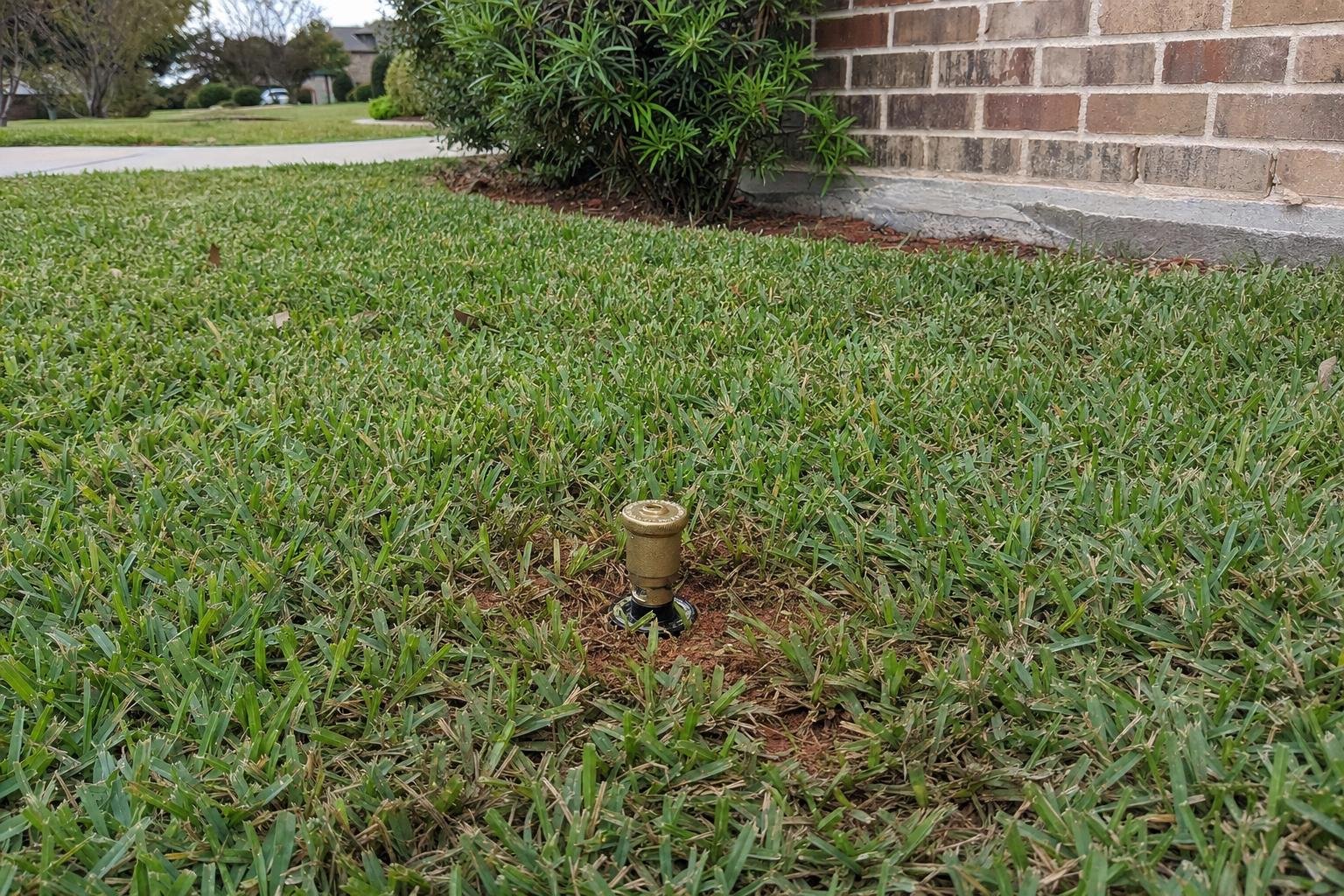
We start at the controller and work outward. First we confirm it has power and a working program, and that the main shutoff valve is open. Those checks cost nothing to fix, and skipping them is how people end up paying for a repair that didn't need doing.
Then we run the affected zone and watch it. We look for visible leaks, soggy spots, heads that don't operate, and heads that don't cover the area they're supposed to. What we see tells us whether the trouble is at a single head, in the line, or at the valve. The quote is written from that, not from a guess made over the phone.
The price follows the fault. A single replaced head is a small job. Digging out a broken line, replacing a valve, or fixing several zones that never covered properly costs more. Time on site, parts, and how much digging the yard needs are what move the number.
You get the quote on paper ahead of any digging, with each piece of work and its price listed. Any permit the work requires is noted on it.
A patch fixes the symptom you can see. A proper repair fixes why it happened. If the same head keeps failing, we check its spot in the yard and whether the clay around it is cracking or staying wet. If a zone floods one corner and starves another, swapping the head won't help. The coverage itself needs adjusting.
After the fix we run the zone again and check that it works and covers what it should. That second run is when a lot of hidden problems show up, and it's cheaper to catch them while we're still standing in your yard. Some minor problems can safely wait, and we'll say so on the visit.
Before you call, run the zone that's giving you trouble and note what you see: where the water pools, which heads stay down, which patches of lawn get missed. Glance at what the controller is showing too. If there's a lot of standing water, turn the system off until we've looked.
When you call, you describe what you've seen and we ask which zone is affected and what the controller is doing. The call is free, and nobody asks you to book or approve a repair on it. If a visit makes sense, we'll set it up. You get the diagnosis and the written quote, and what happens after that is up to you. We repair sprinklers across Denton, so give us a call.
These numbers are a reasonable place to start, and we'll explain what moves a price up or down.
$60–$80
$70–$275
$100–$350
So you know what you're looking at before anyone shows up.
What it means: A clogged nozzle, leaking line, or valve that does not open fully can reduce pressure at the heads.
What we check: Check zone pressure, nozzle condition, and valve operation.
What it means: A kink or damage in the drip tubing can interrupt water delivery.
What we check: Inspect drip tubing for kinks or damage.
What it means: A clogged nozzle or screen, a misdirected head, or inadequate pressure can reduce or distort spray.
What we check: Inspect the nozzle, screen, head angle, and zone pressure.
What it means: A controller signal problem, damaged wiring, or a faulty valve solenoid can prevent a zone from activating.
What we check: Test controller output, wiring, and solenoid operation.
Based in Denton, TX and the nearby communities, Corinth, Highland Village, and Lantana among them. Call (940) 304-8736 to confirm your address is on our map.
7 communities served.
We match the choice to how you'll use it, not to what's handy.
No obligation
Call (940) 304-8736What happens next
What happens after you get in touch, step by step:
Let us know what's going on and how long it's been happening, and you'll hear what we honestly think.
We come out and measure what's actually happening, and you see what we see.
You get the scope and the price in writing, and nothing starts until you've read it.
We make the repair and test that it holds, and the work is checked before we leave.
A short call is usually enough, no obligation.
Serving Denton, TX and surrounding areas.